Showing posts with label design and make. Show all posts

Wednesday, 22 May 2013

Rube Goldberg and simple and compound machines

It's been quite an effort and a learning curve to say the least, but I have finally finished the Simple and Compound Machines Unit that I have been working on. 

I recall teaching this unit with my Stage 2 students a few years ago and actually incorporated it with the work of Rube Goldberg. We (my students and I) thought his work was really fun and interesting and it certainly sparked a light of imagination in the eyes of my students. 

Many of us would have seen adverts on television that used Rube Goldberg machines, which in a nutshell are machines that intentionally take a large number of steps to complete a simple task, such as turning off a lightbulb in 20 steps. Simple machines are connected to one another to complete the task. It's fun to watch, but as my students discovered, it is painstaking to create a rube goldberg machine and have it work repeatedly.


As you can see from these Rube Goldberg machines made by university students.There is no reason though why younger children can't make them and in fact the youngest students I had doing it were in year 3. When looking at these machines in actions though it is clear they are made up of a range of simple machines working together.These videos are a great precursor or final display at the end of the simple and compound machines unit I have just finished.The unit is suitable for students in years 3-5, but in the Australian version, it is aligned with the year 4 science curriculum elaborations.This is one of the biggest unit's I have written and I am so proud of how comprehensive it is. 

It includes:


  • A teacher’s guide with thorough explanations of concepts included,
  • Assessment for each of the activities included,
  • Comprehensive extension work for three of the activities to extend students laterally, 
  • Full activity descriptions,
  • 6 x Bright and fun simple machines posters
  • Assessment worksheets
  • Extension worksheets
  • Investigating scientifically and design and make student reference guide
  • Testing simple machines worksheets for practical activities,
  • Extensions worksheets
  • Simple machine activity stations cards to laminate
  • Design and make planning pages
  • Simple and compound machines PowerPoint presentation.


If all elements of this unit are taught it could take a year 4 class approximately 8 weeks. Otherwise it can be broken down and used as smaller resources.

Students will love undertaking the acitivities and I can't wait to teach it to my students in the future.


It's available now in USA and Australian versions in my TpT store and on Teacher's Marketplace.


Please let me know what you think of it.


Monday, 6 May 2013

Starting with the basics; the processes we must follow.

For years of teaching elementary/primary school aged students, I struggled with how to create the best plans for students to best apply the investigating scientifically and design and make processes in my lessons.
Of course we have to start with the basics of what the two processes look like, then get into the nitty gritty of how to implement them in a classroom.

The process of Investigating Scientifically is as follows;


In part from the NSW Department of Education and Training 2005


This is the basis from which all science invesigations should be developed. Of course the level of complexity to which you teach it will be based on your grade level. For example I wouldn't teach a kindergarten student to write a hypothesis, but I certainly would ask them to make predictions and try to justify those to me. Any way we can encourage our students to think independently is great training for them.

When teaching science practically we are generally either teaching students to investigate scientifically or to design and make. 

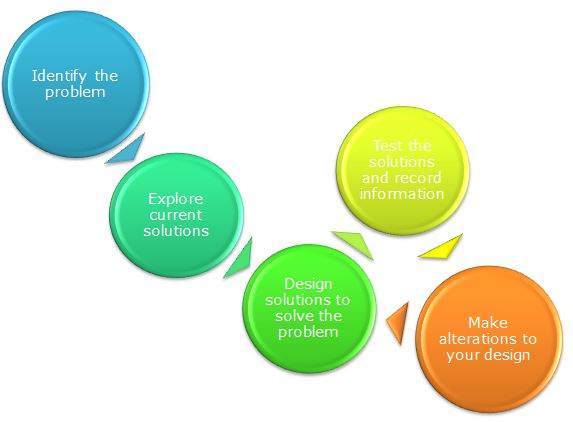
The Design And Make process is as follows. 


This really gives students an opportunity to let their creative juices flow. Even from kindergarten they can be learning to identify an issue, create solutions for it, evaluate those solutions then make changes to their original ideas.

In the coming blogs I will be discussing how to create proformas for students to use in their science work when completing these processes and take a closer look at the meat and bones of a scientific investigation. We will look at 'fair testing', writing hypothesis and predictions and how students can collect information from which to base their results.


Learning to teach science well

Day one of kindergarten science class and I ask my students what they believe science is? 
Every year the response was the same; 'We will blow things up and make potions'. 
The image kids have in their mind seems to have come in part from tv, movies and books, but some kids really love science and read about it with their parents or do experiments on the weekend. They understand that there is so much more to science and that it is such a vastly wide subject. There is bound to be a theme they are enthused about although it may not mean they like every science lesson. 
Either way, they are usually keen. Bright eyed and eager to know; 'What will we be learning about this term?'


I have seen many young students enthusiastic for their school science education, only to become disillusioned and unenthralled by the lessons delivered. Bored with worksheets, fact sheets on inventors and videos, they wanted to get their hands dirty, make something fly or test something. They wanted to create, to work in groups, and 'do stuff' but mostly to not have to sit and write or be talked to. Of course, most units of work have some element of this, but for some this is all they experience. 
I believe that for some elementary school teachers, teaching science can seem intimidating. It requires the teacher to not only teach in a different way, to use and organise a lot of resources, but for the teacher to let go of the control of a highly structured class and accept some temporary mess and let their students move around.


Once I was able to overcome this, I found teaching science fun and of course the students enjoyed it more. I learned to expect the unexpected from them and let their imaginations and creativity run wild.